
Brake Pad Spring Clips & Why You Need Them

Brake pad spring clips (worn out example shown above) have two main functions when fitted, the first being to apply a light spring pressure between the caliper carrier and the brake pads – eliminating vibration which is the main cause of brake squeal. The second function is that they are usually fairly corrosion resistant and very smooth – giving your brake pad something smooth to slide against.
Every time you press your brake pedal – hydraulic pressure pushes the brake fluid from the reservoir down the lines to your calipers, squeezing the pads against the disc and making you slow down and stop from the friction created between the pad and the disc. When you release the pedal the pressure releases on the caliper piston and the caliper will, if in good working order, release the pressure on the pads allowing them to move back away from the discs. The movement is only a small amount, around one millimetre but it is enough that the pads no longer exert a force on the brake disc.
When the spring clips are worn out though, they become corroded, scratched, pitted and weak, the pads will be reluctant to move away from the discs and this is where trouble starts….
Take this customers car for example, whoever fitted the last set of pads and discs completely omitted the lower brake pad spring clips, leaving the pads to ride the now rusty brake caliper carrier, drastically shortening the life and effectiveness of the brakes. Take a look at the brake discs below, its obvious which one is new, but pay attention to the old one, its badly scored and has fatigue cracks on it, typical of a high mileage car – however this is not a high mileage car – and that disc is only a matter of months old!
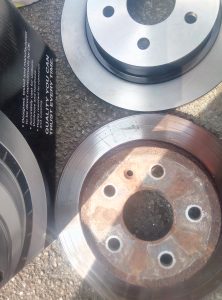
In just a few months, the trapped brake dust, rust and other debris can build up and corrode the caliper carrier to a point where the brake pads can’t move effectively. The brake caliper can push the pads towards the discs because of the massive amount of pressure the caliper can apply, it can easily overcome the force required to push the brake pad through the muck and rust and make it bite the disc – but when you release the brake pedal, and release the pressure the brake pads – quite often they will refuse to let go of the disc completely – effectively they are still braking, and will be until they are removed and everything is cleaned up or replaced! This is what happened to this customers car and burnt out a perfectly good set of rear brakes in a matter of months – all over a set of spring clips costing less than a tenner!

In the picture we’ve fitted a new disc and one pad- and if we fitted brakes like the last person to do this car, we’d just slap the other pad in and shout job done. We tend to do things properly though so before the rest of it went back on the car, the caliper carrier came back off and it was cleaned and descaled in the areas the spring clip will contact and new spring clips fitted, they can be seen below between the brake pad and caliper carrier.

After having the discs and pads replaced, making sure to renew the spring clips and clean as much rust and crud off all the contact areas as possible the car will now brake more efficiently, brake quietly with no squeals or vibrations and fuel economy and performance should now return to normal as the brakes are no longer sticking on.